What Is Neecha and Uchcha? Understanding Debilitated and Exalted Planets
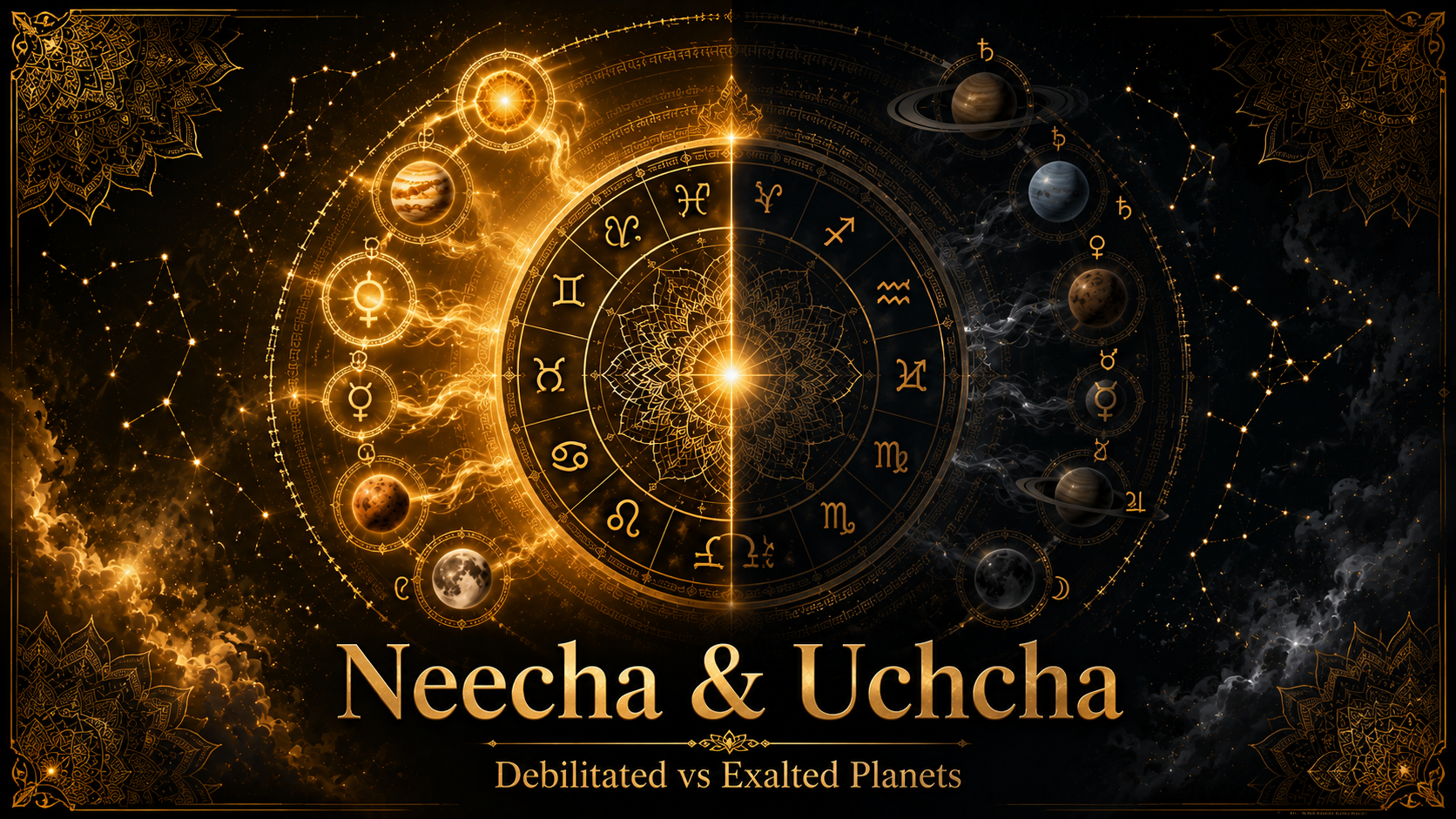
In Vedic astrology, an exalted planet (Uchcha) is traditionally considered to express its qualities with greater strength in a particular zodiac sign, while a debilitated planet (Neecha) is believed to face challenges expressing its natural characteristics. However, their influence always depends on the complete birth chart.
When reading a birth chart, you may come across terms like Uchcha (exalted) and Neecha (debilitated). These concepts describe the condition of a planet in a particular zodiac sign and are an important part of chart interpretation.
A common misconception is that an exalted planet is always beneficial and a debilitated planet is always harmful. In reality, Vedic astrology evaluates planetary dignity alongside many other chart factors before reaching any conclusion.
What Are Exalted and Debilitated Planets?
Every planet has zodiac signs where it is traditionally believed to function most naturally or with the greatest strength. This state is called exaltation (Uchcha).
Likewise, each planet also has a sign where expressing its natural qualities may be more challenging. This condition is known as debilitation (Neecha).
These placements describe a planet's dignity, not whether it is automatically good or bad.
Exalted vs Debilitated Planets
| Exalted Planet (Uchcha) | Debilitated Planet (Neecha) |
|---|---|
| Traditionally expresses its qualities strongly | May express its qualities with greater challenges |
| Considered to have higher dignity | Considered to have lower dignity |
| Interpretation depends on the complete chart | Interpretation also depends on the complete chart |
| Not automatically beneficial | Not automatically harmful |
Why Planetary Dignity Matters
Planetary dignity helps astrologers understand how comfortably a planet may express its natural characteristics.
For example, an exalted planet may indicate greater confidence in expressing its qualities, while a debilitated planet may require additional support from other chart factors.
However, dignity alone never determines the outcome of a birth chart.
Does an Exalted Planet Always Give Positive Results?
No.
Even an exalted planet can produce mixed results depending on factors such as:
- House placement
- Planetary aspects
- Conjunctions
- Functional benefic or malefic status
- Mahadasha and Antardasha
- Overall planetary balance
An exalted planet placed in a challenging house or influenced by difficult aspects may express itself differently than expected.
Is a Debilitated Planet Always Weak?
Not necessarily.
A debilitated planet does not automatically become ineffective or harmful.
Traditional Vedic astrology describes several situations where the effects of debilitation may be reduced or modified, including favorable planetary relationships and specific cancellation conditions.
This is why astrologers always study the complete birth chart before interpreting planetary dignity.
Why the Complete Birth Chart Matters
Understanding exalted and debilitated planets requires looking beyond one planetary placement.
Astrologers also evaluate:
- Planetary strength
- House placement
- Lagna (Ascendant)
- Planetary aspects
- Yogas
- Divisional charts
- Dashas
- Planetary transits
These elements work together to create a balanced interpretation.
Related Reading: What Is Lagna (Ascendant)?
Frequently Asked Questions
What is an exalted planet in Vedic astrology?
An exalted planet (Uchcha) is traditionally believed to express its natural qualities strongly when placed in a specific zodiac sign.
What is a debilitated planet?
A debilitated planet (Neecha) is traditionally considered to face challenges expressing its natural qualities, although its interpretation depends on the entire birth chart.
Is an exalted planet always lucky?
No. Its influence depends on house placement, aspects, Dashas, and other planetary conditions.
Can a debilitated planet still give good results?
Yes. Traditional Vedic astrology recognizes that a debilitated planet may produce favorable outcomes depending on the complete horoscope and supporting planetary combinations.
Final Thoughts
Understanding exalted and debilitated planets is an important step in learning Vedic astrology. While Uchcha and Neecha describe a planet's dignity, they are only one part of a much larger picture.
For accurate interpretation, always study planetary dignity alongside house placements, aspects, Dashas, and the complete birth chart rather than relying on a single factor.
Continue Learning
- The 9 Planets (Navagraha) in Vedic Astrology
- The Significance of Saturn (Shani) in Vedic Astrology
- How to Read Your Kundli
- How Planetary Transits Influence Your Birth Chart
Note: This article is intended for educational purposes and is based on traditional Vedic astrology principles. Interpretations may vary depending on the complete birth chart and the astrological tradition followed.