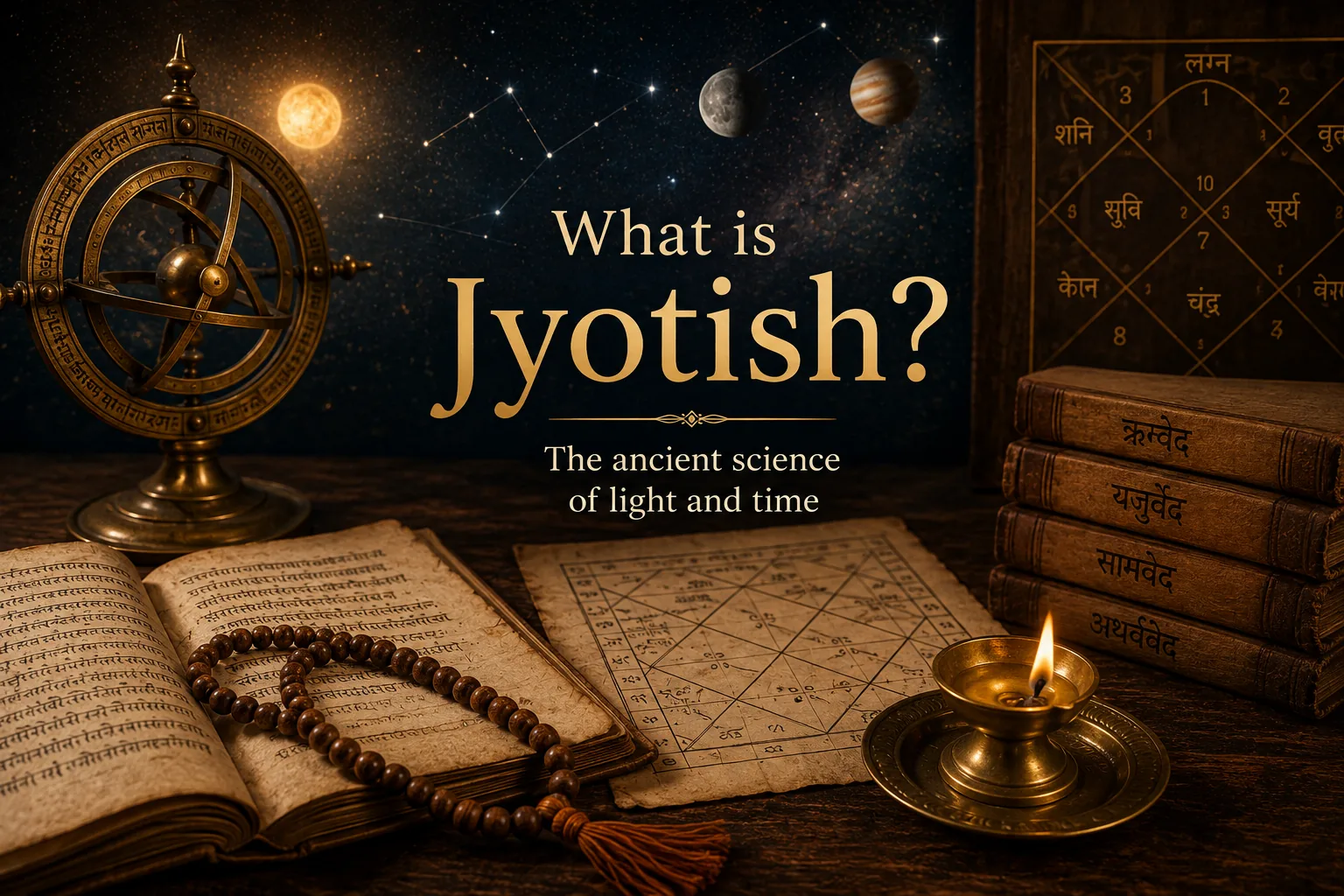
What is Jyotish?
Jyotish is the [traditional Sanskrit](Encyclopaedia Britannica – "Jyotisha" / "Vedanga" reference entries) name for what is commonly translated in English as "Vedic astrology" a system of study rooted in ancient Indian texts that combines astronomical observation with a symbolic framework for interpreting a person's birth chart and the timing of events. The word itself is often translated as "the science of light," pointing to its original focus: tracking the movement of celestial bodies as sources of light and using that movement as a structured reference point.
Where the Word Comes From
Jyotish comes from the Sanskrit root jyoti, meaning light or luminary, combined with isha, meaning lord or master giving a name that roughly translates to "lord of light" or, more commonly, "science of the luminaries." This etymology reflects Jyotish's original scope more accurately than the English word "astrology" does: it began as a discipline focused on the observable movement of the Sun, Moon, and planets, with the interpretive layer reading a birth chart for personal meaning developing as one branch within a much larger body of astronomical and calendrical knowledge.
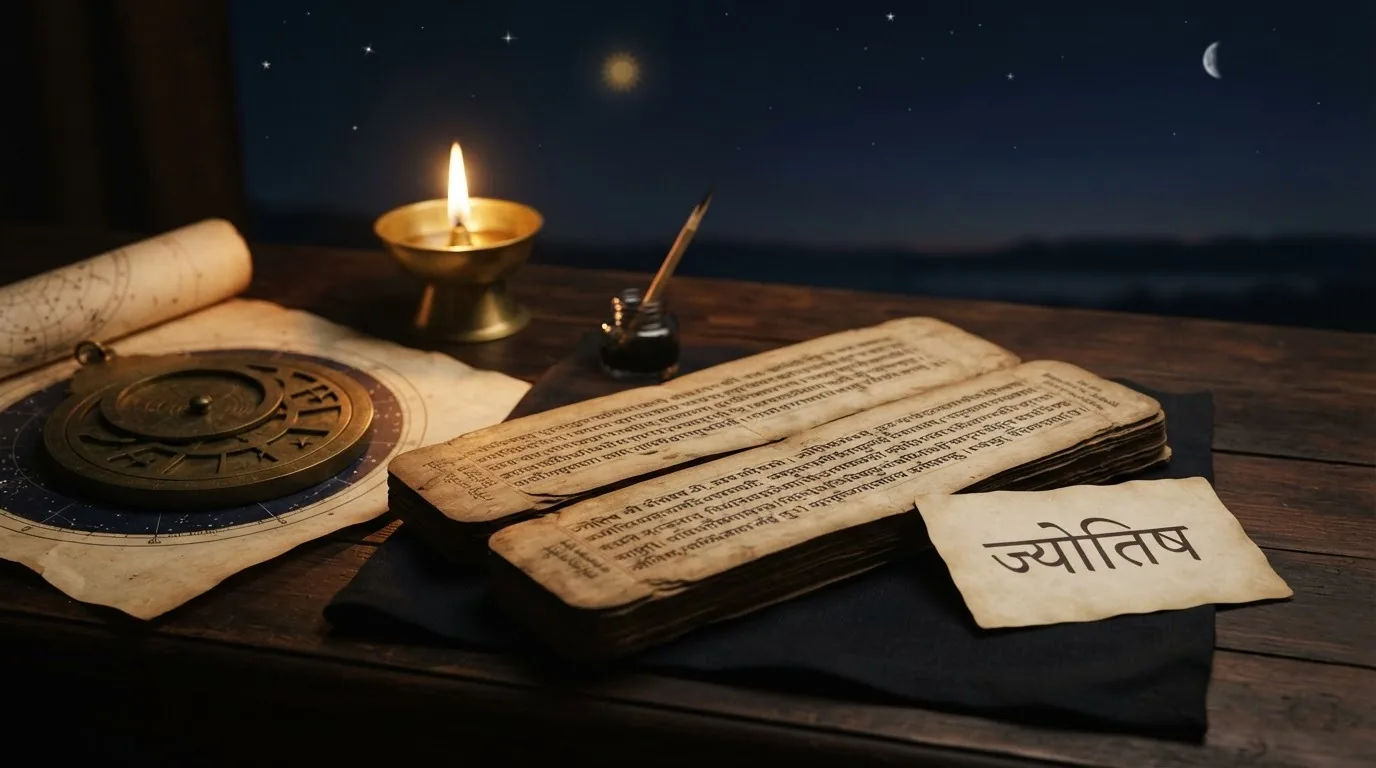
Jyotish as a Vedanga: Its Place in Vedic Learning
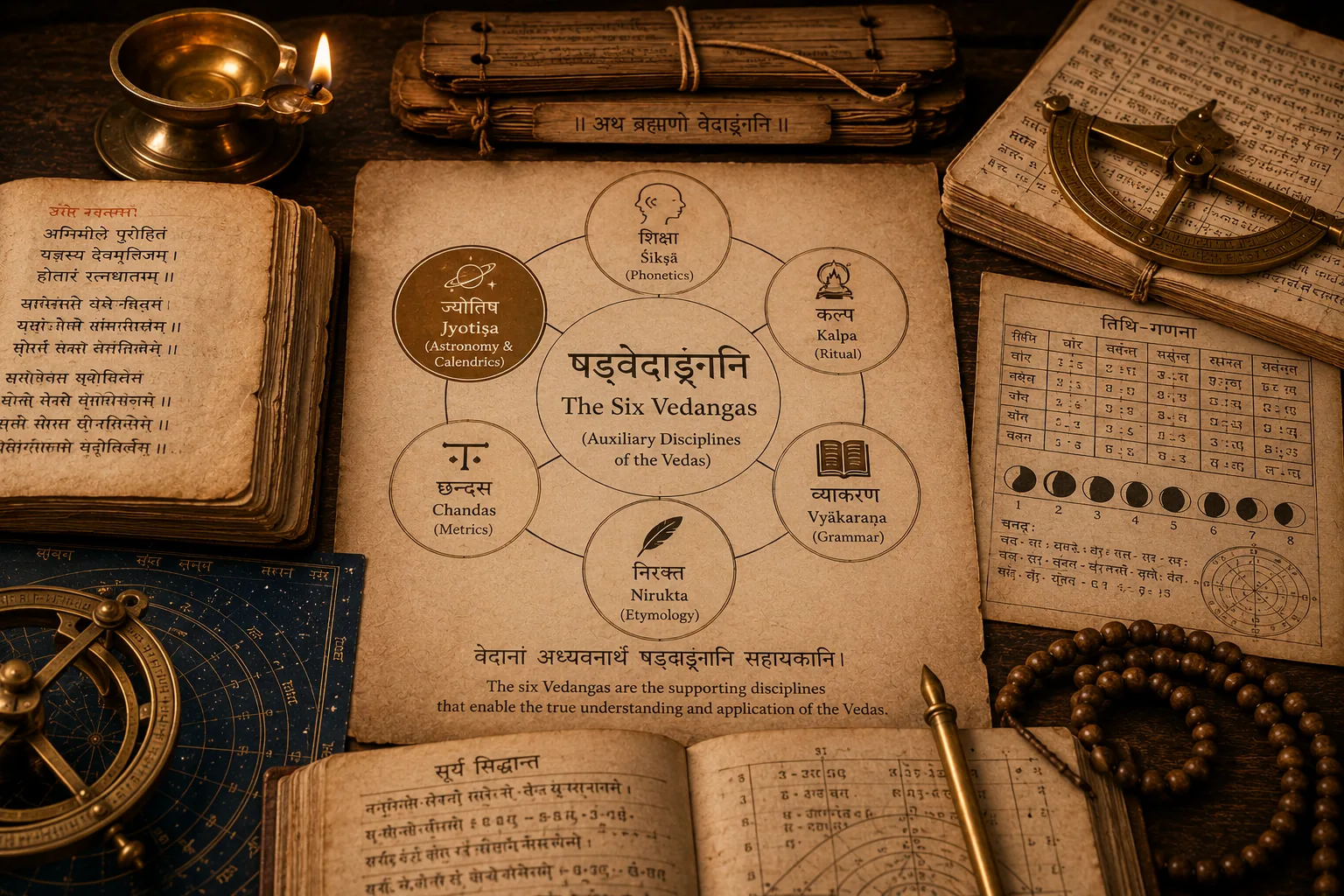
Jyotish holds a specific, formal position within the traditional Vedic knowledge system: it's classified as one of the six Vedangas auxiliary disciplines developed to support the correct study, recitation, and application of the Vedas. The six Vedangas cover phonetics, ritual, grammar, etymology, metrics, and Jyotish, which specifically handled the astronomical and calendrical calculations needed to correctly time Vedic rituals and ceremonies.
This is worth pausing on, because it reframes what Jyotish originally was: not a stand-alone predictive system, but a support discipline built to answer a practical question when, precisely, should a given ritual take place? The birth-chart interpretation most people associate with "astrology" today developed later, as an extension of this original timekeeping and observational function.
The Three Branches of Jyotish
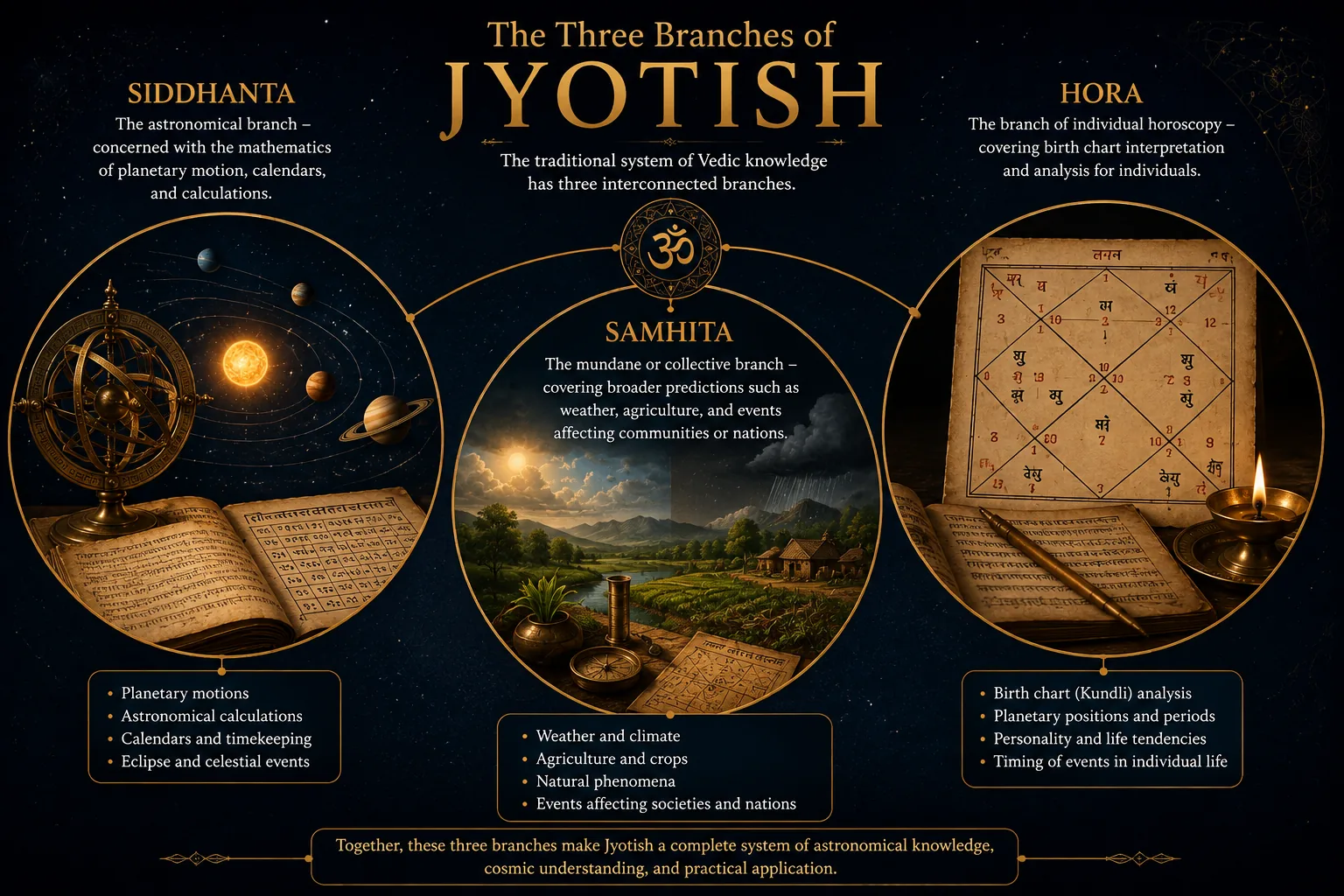
Classical Jyotish is traditionally divided into three branches, each with a distinct focus:
-
Siddhanta : The astronomical branch, concerned with the mathematics of planetary motion, calendars, and the calculations underlying everything else in the system
-
Samhita : The mundane or collective branch, covering broader predictions such as weather, agriculture, and events affecting communities or nations rather than individuals
-
Hora : the branch most people mean when they say "astrology" today, covering horoscopy and birth-chart interpretation for individuals
Vedic Shruti's tools and content sit primarily within Hora, though the [astronomical rigor of Siddhanta](Indian Institute of Astrophysics (IIA) – historical Indian astronomy resources) is what makes tools like the Panchang and Kundli calculators accurate in the first place the two branches are connected, not separate systems.
Jyotish vs "Astrology": Why the Words Aren't Quite Interchangeable
"Astrology" is a useful, widely understood English translation, but it's an imperfect one. In common usage, "astrology" often narrows to mean personal horoscope reading alone which is really just the Hora branch of a much broader traditional discipline that also encompasses astronomical calculation and calendrical timing. Using "Jyotish" more precisely signals this wider scope, and it's also the term many practitioners prefer when distinguishing the Vedic system from Western astrology, which developed along a different historical and methodological path.
A full comparison of how Vedic and Western astrology actually differ in zodiac calculation, house systems, and interpretive approach is a large enough topic to deserve its own dedicated discussion rather than a summary here.
Why This History Matters for How You Read a Chart
Understanding Jyotish's origins isn't just background trivia. It shapes how a reading should reasonably be approached. Because the system's roots are astronomical and calendrical rather than purely predictive, the most defensible use of a chart is descriptive and reflective: identifying patterns, timing windows, and tendencies, rather than issuing fixed, deterministic verdicts about a person's life. This is also consistent with how Vedic Shruti frames every reading across the site as structured reflection grounded in a genuinely old and mathematically rigorous tradition, not as fortune-telling dressed in Sanskrit terminology.
FAQs
What does the word Jyotish actually mean?
Jyotish translates roughly to "science of light" or "science of the luminaries," from the Sanskrit roots jyoti (light) and isha (lord/master), reflecting its origins in tracking celestial movement.
Is Jyotish the same as astrology?
"Astrology" is a common English translation, but Jyotish traditionally covers a broader scope including astronomical calculation and calendrical timing beyond just individual horoscope reading.
Why is Jyotish called a Vedanga?
It's one of six traditional auxiliary disciplines developed to support the Vedas, specifically handling the astronomical and calendrical calculations needed to correctly time Vedic rituals.
What are the three branches of Jyotish?
Siddhanta (astronomical calculation), Samhita (mundane/collective predictions), and Hora (individual horoscopy) with Hora being what most people today mean by "astrology."
Is Jyotish the same as Western astrology?
No. While both systems interpret planetary positions, they differ in zodiac calculation, house systems, and interpretive approach a distinction covered in more depth in a dedicated comparison article.
Conclusion
Jyotish is a far older and broader discipline than the single English word "astrology" usually conveys rooted in genuine astronomical observation, formally classified as a Vedanga, and built from three interconnected branches rather than one narrow predictive practice. Understanding that history is a useful foundation before diving into any specific chart reading, since it's the reason Vedic Shruti frames every reading as reflective and pattern-based rather than as a fixed prediction. Ready to see this tradition applied to your own chart? [Generate your free Kundli] to explore your birth chart, or head back to the [Astrology 101 hub] to continue through the fundamentals.