
What Is a Varga Chart? Understanding the Navamsa (D9) Chart in Vedic Astrology
Most people begin their Vedic astrology journey with the birth chart (D1 or Rasi chart). But experienced astrologers rarely stop there.
To understand marriage, career, spiritual growth, or the true strength of planets, they often turn to Varga Charts—specialized divisional charts that provide a more detailed perspective.
Among these, the Navamsa (D9) chart is considered the most important. It refines the promises of your birth chart and offers deeper insight into relationships, inner development, and long-term planetary strength.
In this guide, you'll learn:
- What a Varga Chart is
- Why divisional charts matter
- What the Navamsa (D9) chart reveals
- How it differs from your birth chart (D1)
- How beginners can start reading their D9 chart
What Is a Varga Chart?
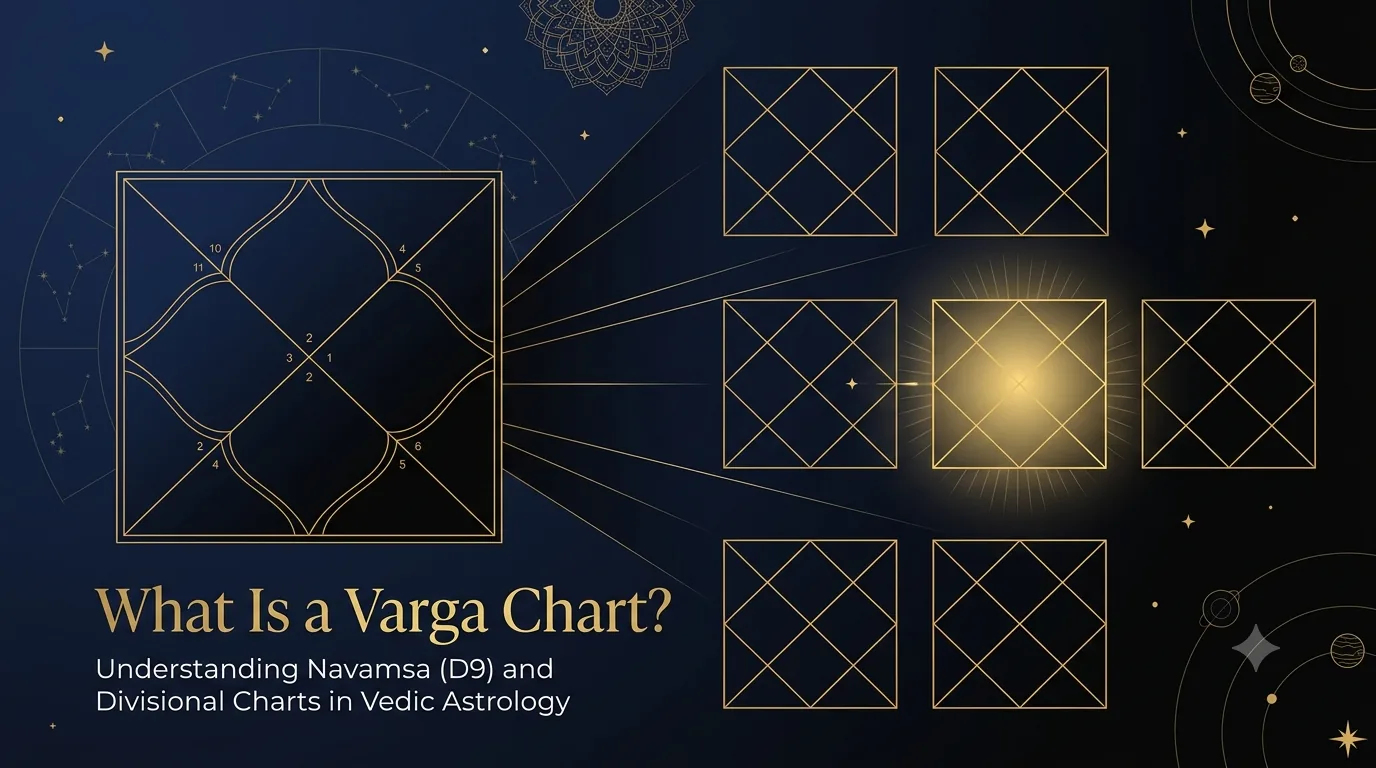
A Varga chart is a divisional chart in Vedic astrology, created by mathematically dividing each zodiac sign in your birth chart into smaller segments to zoom in on one specific area of life—marriage, career, spirituality, or wealth.
Think of your main birth chart as a wide-angle photograph, while each Varga chart acts like a zoomed-in lens focusing on one important aspect of life.
The word "Varga" simply means "part" or "division" in Sanskrit.
Classical Vedic astrology texts—most notably Brihat Parashara Hora Shastra by Sage Parashara—describe sixteen divisional charts, collectively known as the Shodashvarga.
Each chart:
- Uses a different mathematical division
- Recalculates planetary positions
- Reveals details that aren't obvious in the birth chart alone
This means the same planet may occupy a different sign in each Varga chart, highlighting different strengths and life themes.
What Is the Navamsa (D9) Chart?
The Navamsa, also called the D9 chart, is the most important Varga chart in Vedic astrology.
It is created by dividing every 30° zodiac sign into nine equal parts, each measuring 3°20'.
Astrologers primarily use it to study:
- Marriage and relationships
- Long-term partnerships
- Spiritual maturity
- The true strength of planets
While the birth chart (D1) shows the broad blueprint of life, the Navamsa is traditionally treated as its refined version.
A planet that appears powerful in your birth chart but occupies a weak position in the Navamsa may not deliver its full potential. Likewise, a planet that appears average in the D1 chart can become significantly stronger in the D9.
How Is the D9 Chart Different From Your Birth Chart (D1)?
Your birth chart (D1) is created directly from:
- Birth date
- Birth time
- Birth place
The Navamsa chart is derived from the D1 chart, meaning no additional birth information is needed.
Instead, it applies a different mathematical calculation to the same birth data.
Birth Chart (D1)
The D1 chart provides the broad outline of your life:
- Career
- Family
- Health
- Finances
- Personality
Navamsa Chart (D9)
The D9 chart helps astrologers understand:
- Whether planetary promises are actually strong enough to manifest
- Relationship patterns
- Marriage compatibility
- Spiritual development
- Inner maturity
Rather than replacing the birth chart, the Navamsa supports and validates it.
What Does the Navamsa Chart Actually Reveal?
Traditionally, astrologers consult the Navamsa chart for four major purposes.
1. The True Strength of Planets
The D9 chart helps determine whether a planet's strength in the birth chart is genuinely reliable.
One of the most respected concepts is Vargottama.
A planet is considered Vargottama when it occupies the same zodiac sign in both the D1 and D9 charts, indicating that its influence is traditionally regarded as especially stable and consistent.
2. Marriage and Partnerships
The Navamsa is widely used to understand:
- Marriage patterns
- Long-term relationships
- Partnership dynamics
- Commitment and compatibility
It doesn't predict a specific outcome but offers insight into recurring relationship themes.
3. Spiritual Inclination
Many classical astrologers associate the D9 chart with:
- Inner growth
- Dharma
- Personal values
- Spiritual evolution
4. The Second Half of Life
Some traditions also use the Navamsa to better understand experiences that become more significant later in life.
At Vedic Shruti, we view the Navamsa as a framework for reflection and pattern recognition, not a guarantee of future events. Your decisions and actions always remain part of the equation.
How Many Varga Charts Are There?
Classical Vedic astrology describes sixteen divisional charts, known collectively as the Shodashvarga.
Although all sixteen exist, most astrologers regularly work with only a few.
| Chart | Name | Primary Focus |
|---|---|---|
| D1 | Rasi Chart | Overall life |
| D7 | Saptamsha | Children |
| D9 | Navamsa | Marriage & planetary strength |
| D10 | Dasamsa | Career |
| D12 | Dwadasamsa | Parents & ancestry |
Each divisional chart adds another layer of understanding instead of replacing the previous one.
Experienced astrologers typically analyze several charts together for a balanced interpretation.
How to Read Your Own D9 Chart
You don't need to calculate the Navamsa manually.
Modern Kundli software automatically generates it using the same birth details required for your birth chart.
For beginners, start with these simple observations:
Compare Planetary Placements
Look at where each planet appears in:
- D1 chart
- D9 chart
Notice whether a planet changes signs or remains the same.
Identify Vargottama Planets
If a planet occupies the same sign in both charts, it is considered Vargottama, which traditionally indicates stronger and more stable planetary influence.
Avoid Isolated Interpretations
Interpreting houses, planetary lordships, yogas, and combinations requires broader chart analysis.
Looking at a single placement without considering the rest of the chart often leads to incorrect conclusions.
If you're unsure, it's usually better to use a structured learning resource or discuss your chart with the Vedic Shruti AI Chat.
Frequently Asked Questions (FAQs)
Is the Navamsa chart only about marriage?
No.
Although marriage is its best-known application, the Navamsa is also used to study:
- Spiritual development
- Planetary strength
- Personal values
- Long-term life patterns
Do I need my exact birth time to generate a D9 chart?
Yes.
Since the Navamsa is derived from your birth chart, it depends on the same precise:
- Birth date
- Birth time
- Birth place
Even small inaccuracies in birth time can affect the chart.
What does it mean if a planet is "Vargottama"?
A planet is Vargottama when it occupies the same zodiac sign in both the D1 (birth chart) and D9 (Navamsa chart).
Traditionally, this indicates that the planet's qualities are more stable and dependable.
Is the D9 chart more important than the birth chart?
No.
The birth chart remains the foundation of every Vedic astrology reading.
The Navamsa acts as a complementary chart that refines and confirms important themes.
How is the Navamsa different from charts like the D10?
Each Varga chart focuses on a different area of life.
For example:
- D9 (Navamsa): Marriage, relationships, planetary strength
- D10 (Dasamsa): Career and professional life
Each uses its own mathematical division.
Conclusion
A Varga chart isn't a separate chart from your birth chart—it is the same birth data viewed through a more specialized lens.
Among the sixteen classical divisional charts, the Navamsa (D9) remains the most widely used because it refines what the birth chart already suggests, especially regarding marriage, planetary strength, and inner development.
Like every tool in Vedic astrology, the Navamsa works best as a guide for thoughtful reflection rather than a fixed prediction.
Ancient wisdom becomes most valuable when combined with awareness, understanding, and your own choices.
Explore Your Navamsa Chart
Curious about what your own Navamsa chart reveals?
Generate your free Kundli on Vedic Shruti to view your D1 and D9 charts side by side, or ask the Vedic Shruti AI Chat a specific question about your planetary placements.
Your journey into deeper Vedic astrology can begin with a single chart—and a better understanding of yourself.