

What Panchang Actually Helps You Do
Panchang is a daily almanac built from five core elements : Tithi, Nakshatra, Yoga, Karana, and Vara (weekday) that together describe the astrological texture of a given day. For daily timing purposes, most people aren't trying to read all five elements in depth. They're trying to answer a much simpler question: is today, or this specific window of today, a reasonable time to do a particular task? This guide walks through exactly how to use the Panchang tool to answer that, step by step.
Before You Start: What You'll See on the Tool
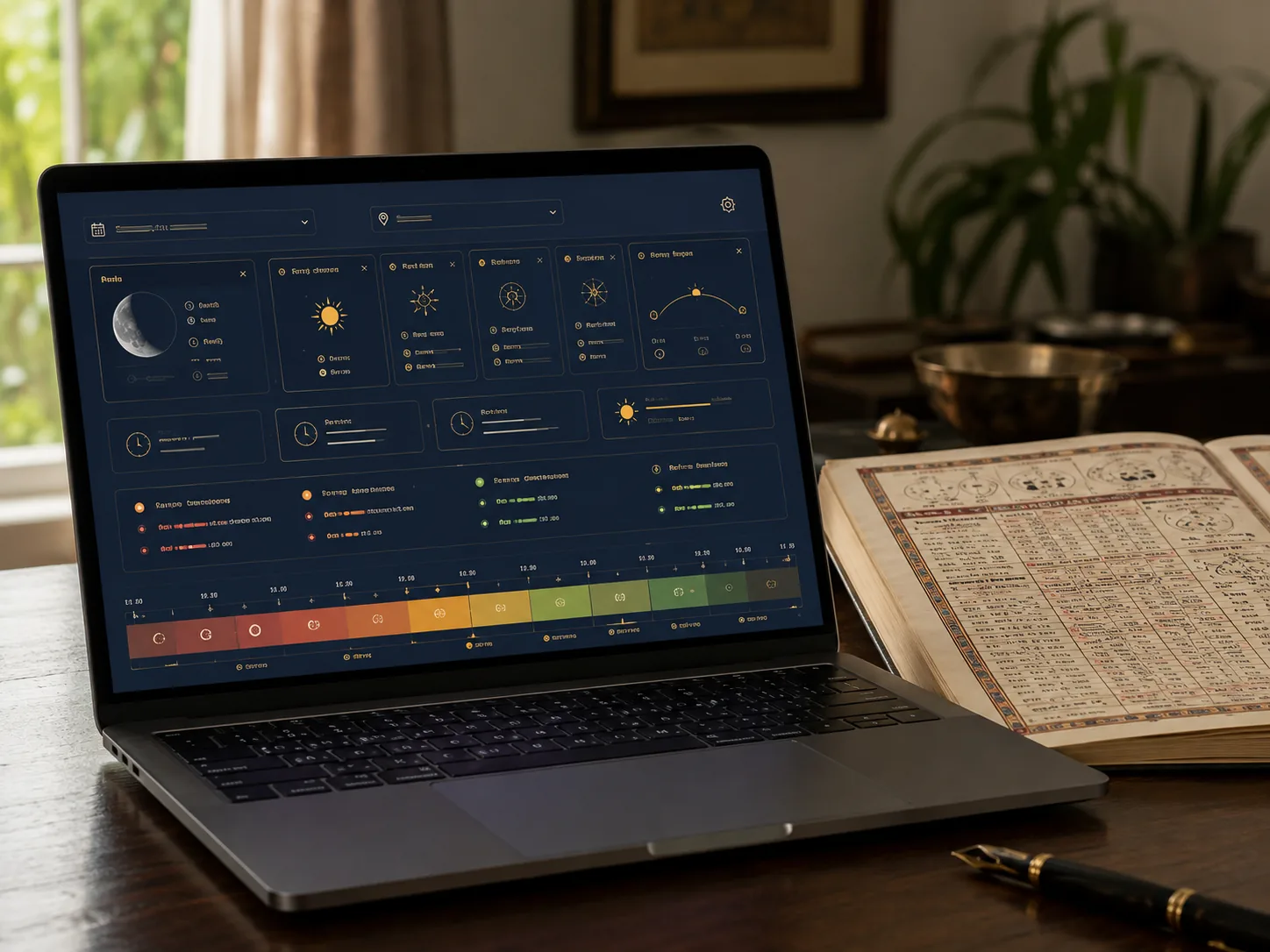
Opening the Panchang tool for any given date and location shows several sections at once: the day's Tithi, Nakshatra, Yoga, and Karana; sunrise and sunset times; and a set of time window blocks including Rahu Kaal, Choghadiya, and sometimes Abhijit Muhurat. New users often feel like they need to understand every field before using any of it, that's not necessary. The steps below focus on the handful of fields that matter most for everyday timing decisions.
Step-by-Step: Using Panchang for Daily Timing
-
● Step 1: Set your date and location correctly. Panchang timings are location-specific, since sunrise and sunset (which several calculations are based on) shift by city. Always confirm the location field matches where the task will actually take place, not just your home city if you're traveling.
-
● Step 2: Check the day's Tithi. The Tithi is shown near the top of the result and gives a general sense of the day's character. Certain Tithis are traditionally considered more suitable for beginnings, celebrations, or important tasks, while others lean more toward rest or completion-type activities.
-
● Step 3: Note the day's Nakshatra. The Nakshatra adds a second layer of context beyond the Tithi. Some Nakshatras are traditionally associated with stability and steady effort, others with movement and change useful context when deciding between two possible days for the same task.
-
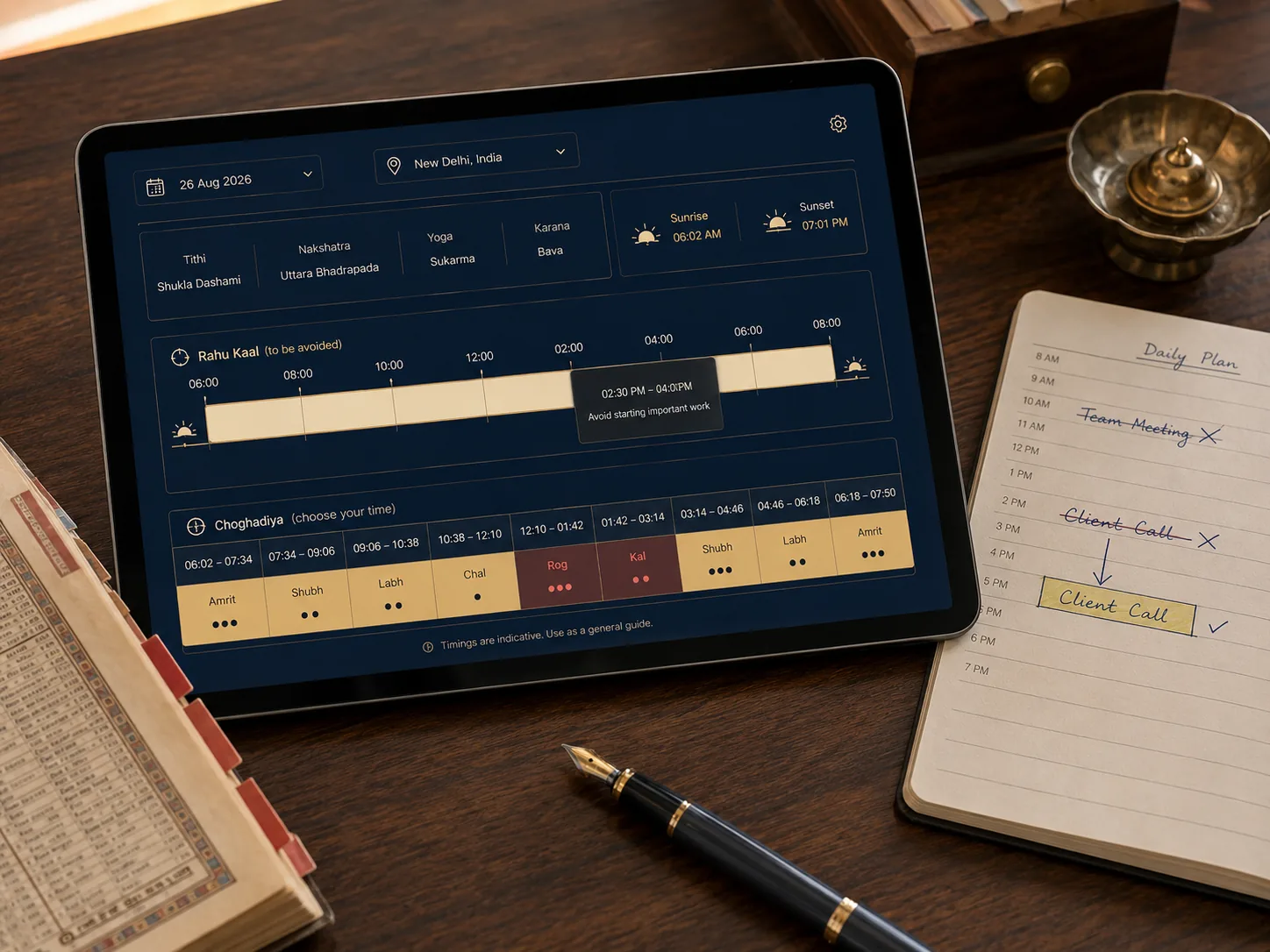
● Step 4: Identify and avoid Rahu Kaal. Rahu Kaal is a roughly 90-minute daily window, shown clearly on the tool, traditionally considered unfavorable for starting new or important activities. This is usually the single most-used field for people checking Panchang quickly & simply noting the Rahu Kaal window and avoiding scheduling around it covers a large share of practical use.
-
● Step 5: Check Choghadiya for a more specific window. Where Rahu Kaal tells you what to avoid, Choghadiya breaks the day into smaller labeled blocks some favorable, some neutral, some to avoid giving a more granular option for picking a specific hour rather than just avoiding one.
-
● Step 6: Cross-check Yoga and Karana for finer detail. These two elements are optional for most everyday use but add finer detail for anyone planning something more significant. They're worth a glance rather than a deep read for routine daily tasks.
-
● Step 7: Match the day's overall reading to your specific task. Once you've noted the Tithi, Nakshatra, Rahu Kaal, and a Choghadiya window, the final step is simply applying that combination to what you're actually planning covered in more detail below.
Matching the Right Element to the Right Task
Different fields carry different weight depending on what you're timing:
-
● Starting something new (a project, a purchase, a trip) Rahu Kaal avoidance and a favorable Choghadiya window matter most
-
● Signing documents or making commitments Tithi and Nakshatra carry more traditional weight here
-
● Routine daily tasks a quick Rahu Kaal check is usually sufficient; the finer elements matter less
-
● Significant life events (weddings, groundbreaking, major purchases) this is where a full Muhurat calculation, not just daily Panchang, becomes relevant
That last point is worth being clear about: Panchang is built for everyday timing decisions. For major life events, a dedicated Muhurat calculation goes deeper than the daily Panchang view alone.

Common Beginner Mistakes
A few patterns show up often enough to flag directly:
-
● Checking the wrong location using a home-city Panchang while physically somewhere else on the relevant date
-
● Treating every field as equally important most everyday decisions really only need Rahu Kaal and Choghadiya, not a full five-element read
-
● Avoiding Rahu Kaal so strictly that daily life becomes difficult to plan it's one factor to weigh, not an absolute rule that overrides all practical scheduling
-
● Confusing daily Panchang with a full Muhurat calculation they serve different purposes, as noted above
FAQs
What's the easiest way to use Panchang for daily timing?
For most everyday tasks, checking the day's Rahu Kaal window and picking a favorable Choghadiya block covers the practical need you don't need to read every Panchang element in depth.
Do I need to check Panchang every single day?
Not necessarily. It's most useful when planning something specific a start date, an important errand, a commitment rather than as a daily habit for its own sake.
Is Rahu Kaal the same every day?
No, Rahu Kaal shifts daily based on sunrise and sunset times for your specific location, which is why the tool needs an accurate date and location to calculate it correctly.
What's the difference between Panchang and a Muhurat calculation?
Panchang gives a general daily reading suited to everyday timing decisions, while a Muhurat calculation is a more detailed process specifically for major life events like weddings or groundbreaking ceremonies.
Can I use Panchang if I'm traveling to a different city?
Yes, but make sure to set the tool's location to where the task will actually take place, since Panchang timings are location-specific.
Conclusion
Using Panchang for daily timing doesn't require mastering all five of its elements at once. For most everyday decisions, checking Rahu Kaal and a favorable Choghadiya window covers the practical need the deeper elements are there when a task calls for more detail. Once this basic sequence feels familiar, applying it to your own schedule becomes quick rather than overwhelming. Ready to put this into practice? [Check today's Panchang] for your location, or explore the [Muhurat Calculator] if you're planning something bigger than a daily task.