
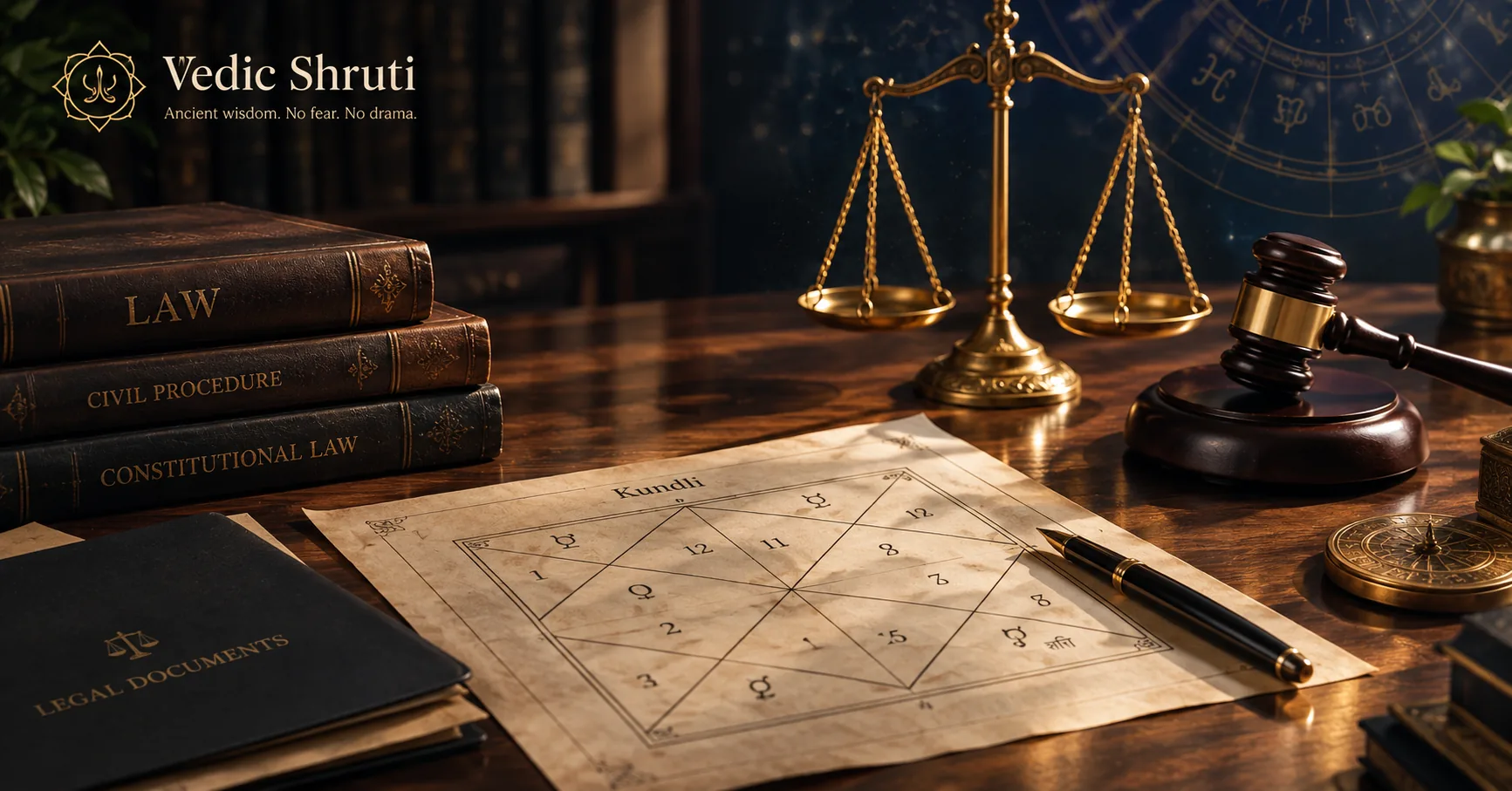
Why People Turn to Astrology During Legal Disputes
A legal dispute a property case, a contract gone wrong, a custody matter, a notice you never saw coming brings its own particular flavor of stress. It moves slowly, it costs money, and most of it sits outside your control. So it's not surprising that legal trouble is one of the most common reasons someone opens a Kundli for the first time.
Vedic astrology has a long tradition of treating litigation as a pattern in the chart rather than a random event. It doesn't claim to predict verdicts. What it offers is a way to understand why a stretch of time feels so heavy, and what tends to lighten it. That's a smaller promise than most people expect, and a more honest one.
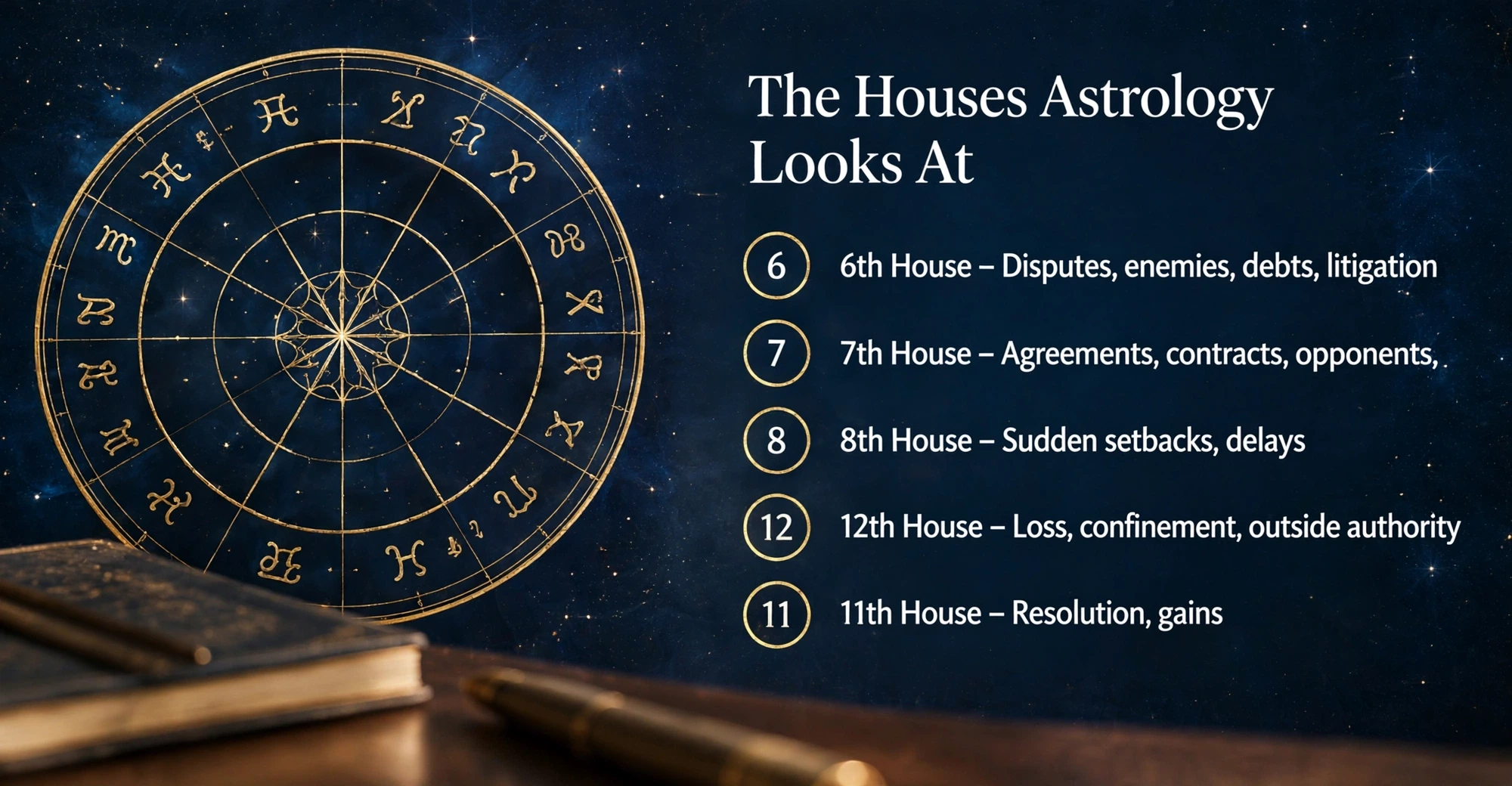
The Houses Astrology Looks At
The 6th house is where classical texts start. It governs disputes, enemies, debts, and litigation broadly sometimes called the house of daily struggle. When the 6th house or its lord is under strain, astrologers read that as a period where conflict surfaces more easily and takes longer to settle.
The 7th house is the other side of the table, literally. It covers agreements, contracts, and opponents, so it's used to understand the other party, not just your own position.
The 8th house is tied to sudden setbacks and delays the reason long, dragging cases often get read through it.
The 12th house relates to loss and to things beyond your direct control, including confinement or matters handled by outside authority.
The 11th house is read for resolution and gains. A well-placed 11th house, or one whose lord connects to the 6th house, is traditionally taken as a sign the dispute is more likely to end in the native's favor.
No single house tells the whole story. Astrologers weigh these five together, along with how their lords relate to the ascendant, before forming a view.
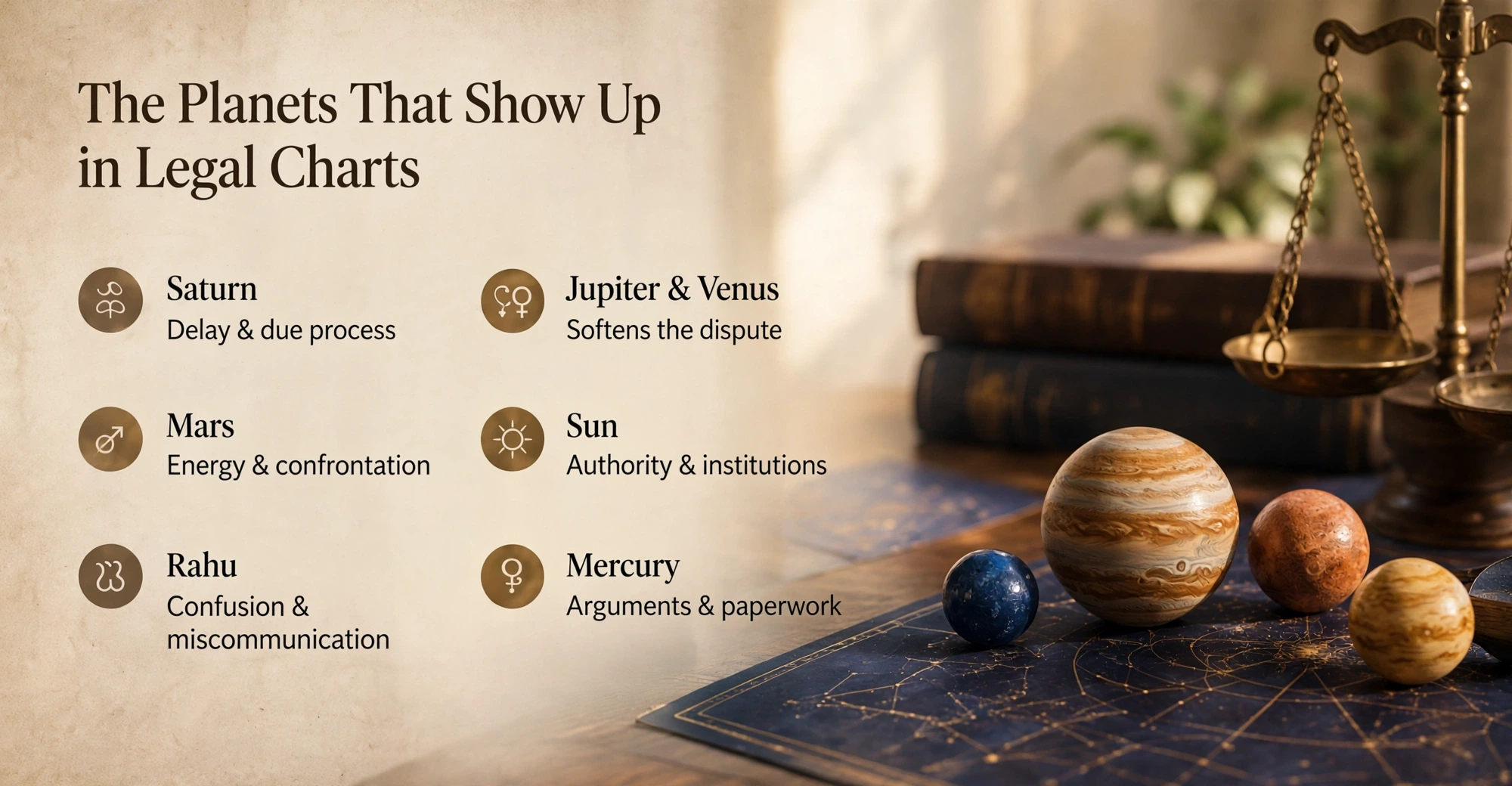
The Planets That Show Up in Legal Charts
Saturn is the planet of delay and due process. Its pull on the 6th house is often why a case drags on for years instead of resolving quickly Saturn doesn't rush, for better or worse.
Mars brings energy, aggression, confrontation. A strong Mars connection to the legal houses can mean a dispute escalates fast, or that the native takes an assertive stance in it.
Rahu is tied to confusion and situations where facts get tangled. Astrologers watch for it when a case involves false claims or miscommunication.
Jupiter and Venus tend to soften things. Their influence on the 6th or 8th house is traditionally read as reducing the odds of a prolonged, damaging dispute.
The Sun relates to authority and official bodies courts, government offices, institutions so its placement says something about how a person's dealings with formal authority tend to go.
Mercury governs arguments, paperwork, communication. A well-placed Mercury is linked to being able to represent your case clearly.
What the Dasha Period Adds
Houses and planets set the potential in a chart. The Dasha and Antardasha the running planetary period is what determines when that potential is actually active. A chart can carry a difficult 6th-house pattern its entire life without a legal issue ever surfacing strongly, simply because the relevant period never activated it. It also explains why the same birth chart can show a genuinely quieter stretch ahead, even after a rough one. Periods change, and so does the weather they bring.
If you've read our piece on the Dasha Calculator, this is the same idea, just applied to one life area instead of the whole chart.
Nuance Over Certainty
This is the part responsible astrology never skips. Aspects, house lordships, the sign a planet sits in, and how several planets combine can shift a reading substantially. A Saturn that delays a case is not the same as a Saturn that also protects the outcome, the difference lives in the details of the individual chart, not in a generic rule. It's also why "my friend had the same placement and lost" doesn't really mean anything. No two charts carry a placement in identical company.
What This Doesn't Mean
It's worth saying plainly, because fear-based claims are common in this space and don't help anyone: a difficult 6th house doesn't mean a case is lost. A strong Mars doesn't mean a dispute is deserved or fated. Astrology can describe tendencies and timing. It isn't a substitute for legal counsel, and it shouldn't be used to predict what a court will decide. Anyone promising a guaranteed outcome, in either direction, isn't practicing this responsibly.
A Practical Next Step
If you're in the middle of a legal matter and want to understand your own chart rather than a general checklist, the useful move is looking at your own Kundli and Dasha, not a generic house-by-house rundown. Vedic Shruti's AI Astrology Chat can walk you through what your specific 6th, 7th, and 8th house placements look like, and which period you're currently in, so you're reading your own chart instead of someone else's.
FAQs
Can astrology predict whether I'll win a court case?
No. It can describe tendencieslikely delays, the nature of the opposition, protective or challenging influences but it shouldn't be read as a prediction of the outcome. Court decisions depend on facts, evidence, and law.
Which house matters most for legal disputes in a Kundli?
The 6th house is the primary one for disputes and litigation, but astrologers read it alongside the 7th (opponents), 8th (obstacles), and 11th (resolution) rather than on its own.
Does Saturn in the 6th house always mean a long court case?
Not necessarily. Saturn is linked to delay, but the effect depends on its sign, its aspects, and whatever else is influencing that house. The same placement can play out very differently across two charts.
What does Rahu's presence in a legal chart usually indicate?
Confusion, misinformation, or situations with unclear facts. It's a caution to seek clarity, not a fixed prediction.
Should I make legal decisions based on my chart reading?
No. A reading can offer context and a sense of timing alongside proper legal advice. It shouldn't replace a conversation with a qualified lawyer.
Conclusion
Legal disputes are stressful enough without fear-based predictions layered on top. What Vedic astrology actually offers here is context: which houses and periods are active, what they tend to mean, where the nuance sits. Not a verdict. Read calmly and alongside real legal counsel, a chart becomes a tool for understanding your own timing not a stand-in for the process itself. Want to see what your own 6th, 7th, and 8th house placements look like? Generate your free Kundli and ask Vedic Shruti's AI Astrology Chat to walk you through your current Dasha period