
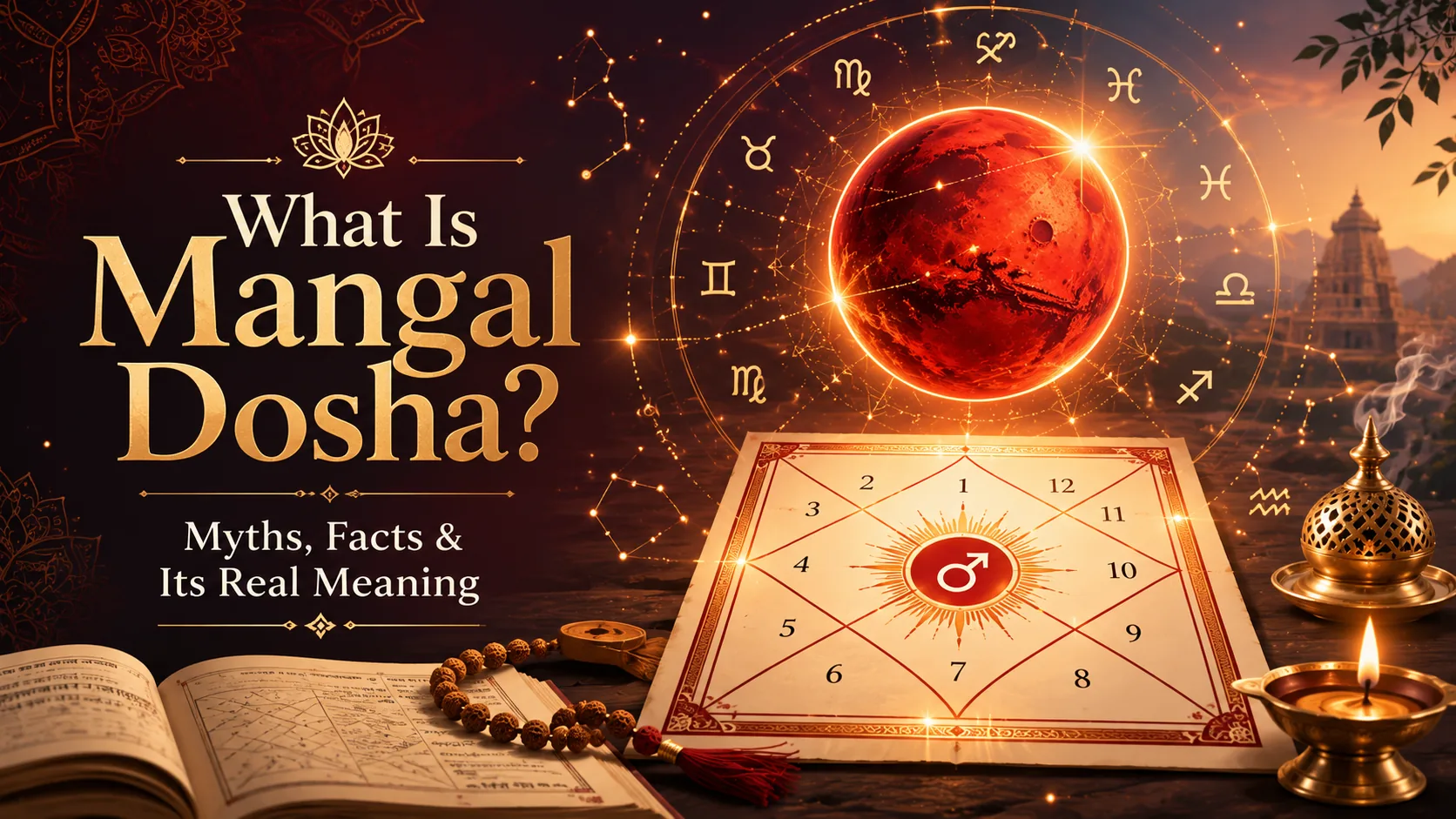
What Is Mangal Dosha?
Mangal Dosha is a condition in Vedic astrology that is traditionally assessed based on the placement of Mars (Mangal) in certain houses of a birth chart. Its significance depends on the complete horoscope, not on Mars' position alone.
If you've ever heard the term Manglik, you've probably also heard myths suggesting it guarantees delays in marriage or relationship challenges. In reality, Mangal Dosha is one of the most misunderstood concepts in Vedic astrology.
A balanced astrological interpretation considers the entire birth chart, including planetary strength, aspects, house placements, and Dashas. This guide explains what Mangal Dosha is, how it is assessed, and why context matters more than labels.
What Is Mangal Dosha?
Mangal Dosha, also known as Kuja Dosha, is traditionally evaluated when Mars occupies certain houses in a birth chart. Mars represents energy, courage, determination, ambition, and assertiveness. Depending on its placement and condition, these qualities may express differently in an individual's life.
The presence of Mangal Dosha does not automatically indicate negative outcomes. Experienced astrologers study the entire horoscope before drawing conclusions.
How Is Mangal Dosha Assessed?
In classical Vedic astrology, Mangal Dosha is traditionally assessed by examining Mars' placement from the Lagna (Ascendant), Moon, and sometimes Venus.
Commonly evaluated houses include:
- 1st House
- 2nd House
- 4th House
- 7th House
- 8th House
- 12th House
The exact interpretation varies depending on the astrological tradition being followed.
Common Myths vs Facts
| Myth | Fact |
|---|---|
| Every Manglik faces marriage problems. | The complete birth chart determines the overall interpretation. |
| Mangal Dosha cannot be reduced. | Many charts include balancing factors or traditional cancellation conditions. |
| Every astrologer interprets it the same way. | Assessment methods vary across different Vedic traditions. |
| Mars is always harmful. | Mars also represents courage, discipline, leadership, and determination. |
Why the Complete Birth Chart Matters
One of the biggest misconceptions about Mangal Dosha is that Mars alone decides a person's future.
In practice, astrologers also evaluate:
- Strength of Mars
- Planetary aspects
- House lords
- Benefic influences
- Divisional charts
- Mahadasha and Antardasha
- Overall planetary balance
These factors help determine whether Mars' energy is strengthened, moderated, or redirected.
Is Every Manglik the Same?
No.
Two individuals may both be classified as Manglik, yet experience completely different life paths because no two birth charts are identical.
Planetary combinations, Yogas, Dashas, and house strengths all contribute to the final interpretation. This is why personalized chart analysis is far more meaningful than relying on a single Dosha.
Frequently Asked Questions
Is Mangal Dosha always harmful?
No. Mars is a naturally powerful planet associated with confidence, action, and determination. Its influence depends on the complete birth chart.
Can Mangal Dosha be cancelled?
Traditional Vedic astrology describes several conditions under which the effects of Mangal Dosha may be reduced or balanced. An astrologer evaluates these alongside the rest of the horoscope.
Does every Manglik have relationship challenges?
No. Relationship compatibility depends on many astrological factors, not just Mangal Dosha.
How can I know if I have Mangal Dosha?
A qualified Vedic astrologer or reliable astrology software can assess Mars' placement and interpret it within the context of your complete birth chart.
Note: This article is intended for educational purposes and reflects traditional Vedic astrology principles. Interpretations may vary depending on the complete horoscope and the astrological tradition followed.