
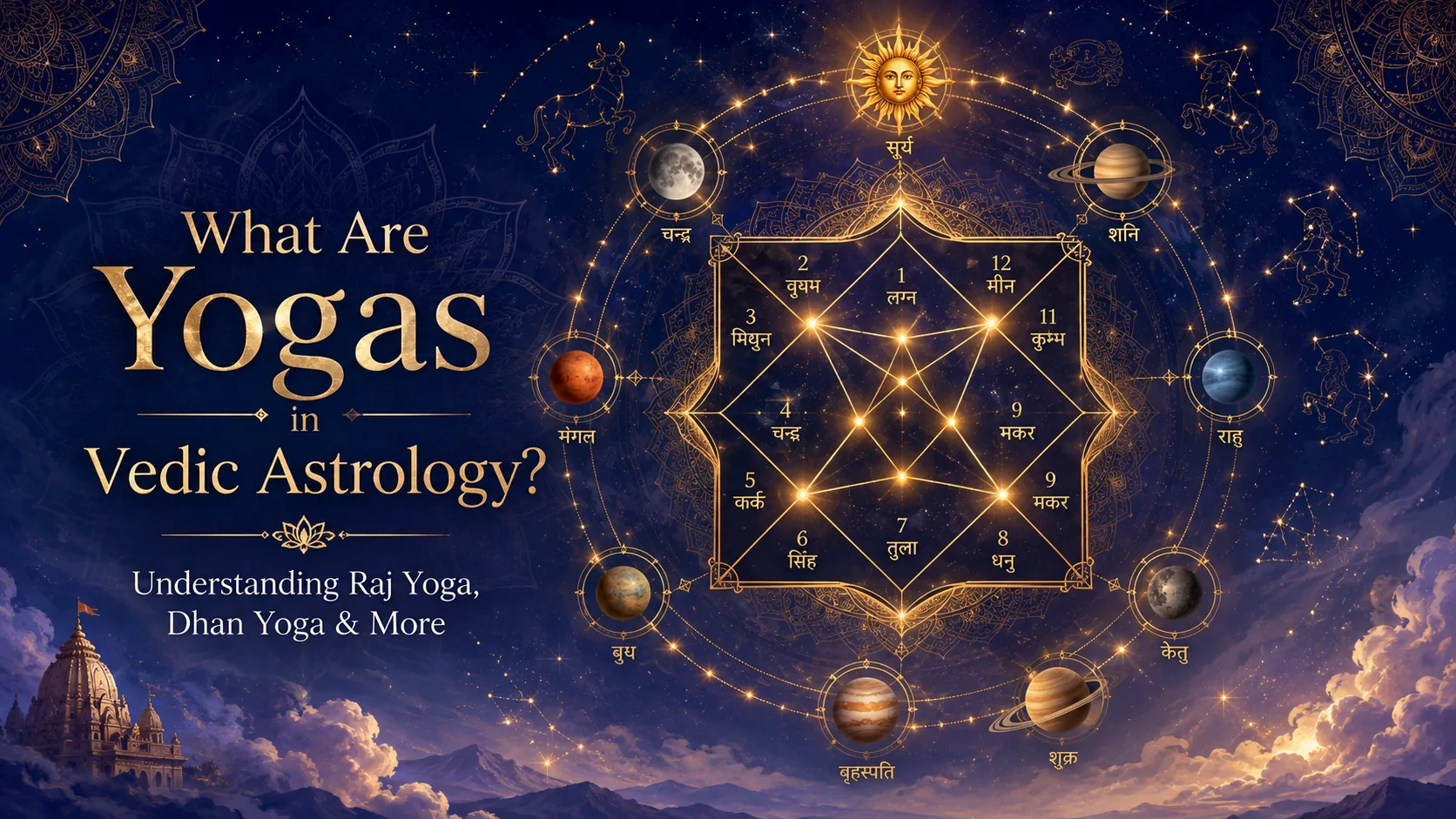
What Are Yogas in Vedic Astrology?
Quick Answer: Yogas in Vedic astrology are special planetary combinations in a birth chart (Kundli) that are traditionally believed to influence areas such as career, wealth, relationships, intelligence, and spiritual growth. Their effects depend on planetary strength, house placements, aspects, and the timing of Dashas.
If you've explored Vedic astrology, you've probably heard terms like Raj Yoga or Dhan Yoga. These are among the many Vedic Yogas that astrologers study while interpreting a birth chart. Rather than predicting a fixed destiny, Yogas indicate potentials that may unfold depending on the overall horoscope and planetary periods.
In this guide, you'll learn what Yogas in Vedic astrology are, how they are formed, and the meanings of some of the most commonly discussed Yogas.
What Are Yogas in Vedic Astrology?
In Vedic astrology, a Yoga is a specific planetary combination formed by the placement, conjunction, or aspect of planets in a birth chart. Classical texts describe these combinations as indicators of different life themes, including prosperity, leadership, learning, relationships, and spiritual development.
However, no Yoga should be interpreted in isolation. Astrologers also consider planetary strength, house rulership, divisional charts, and Dashas before drawing conclusions.
How Are Vedic Yogas Formed?
Vedic Yogas are formed through different planetary relationships, including:
- Conjunctions between planets
- Planetary aspects (Drishti)
- Placement in specific houses
- Exchange of house lords (Parivartana Yoga)
- Strength of planets in their zodiac signs
- Activation during Mahadasha and Antardasha
Because every birth chart is unique, the same Yoga may produce different results for different individuals.
Common Types of Vedic Yogas
| Yoga | Traditionally Associated With |
|---|---|
| Raj Yoga | Leadership, success, authority |
| Dhan Yoga | Wealth and financial prosperity |
| Gaj Kesari Yoga | Wisdom, reputation, confidence |
| Vipreet Raj Yoga | Growth through challenges |
| Budha-Aditya Yoga | Intelligence and communication |
Raj Yoga
Raj Yoga is one of the most well-known Yogas in Vedic astrology. It generally forms when the lords of Kendra (1st, 4th, 7th, and 10th houses) establish a favorable relationship with the lords of Trikona (1st, 5th, and 9th houses).
It is traditionally associated with:
- Leadership qualities
- Career advancement
- Recognition and respect
- Greater responsibilities
Its actual influence depends on planetary dignity, aspects, and the overall birth chart.
Dhan Yoga
Dhan Yoga is traditionally linked with financial opportunities and wealth accumulation. It commonly forms when the lords of wealth-related houses, such as the 2nd, 5th, 9th, or 11th houses, interact favorably.
It may indicate:
- Better financial prospects
- Business success
- Multiple income sources
- Long-term wealth creation
Financial outcomes are also influenced by planetary periods and the complete horoscope.
Gaj Kesari Yoga
This Yoga is formed when Jupiter and the Moon occupy favorable positions from one another.
It is traditionally associated with:
- Intelligence
- Wisdom
- Good reputation
- Emotional balance
- Respect within society
Vipreet Raj Yoga
Unlike many other Yogas, Vipreet Raj Yoga is believed to produce positive outcomes through difficult circumstances. Individuals with this Yoga may overcome obstacles and emerge stronger after periods of challenge.
Budha-Aditya Yoga
When the Sun and Mercury are in conjunction under favorable conditions, Budha-Aditya Yoga may form.
It is commonly associated with:
- Strong communication skills
- Logical thinking
- Business acumen
- Academic excellence
Do All Yogas Give Results?
No. Simply having a Yoga in your birth chart does not guarantee specific outcomes.
Astrologers evaluate several factors before interpreting a Yoga, including:
- Planetary strength
- House placement
- Benefic or malefic aspects
- Combustion or debilitation
- Navamsa and other divisional charts
- Current Mahadasha and Antardasha
This holistic approach provides a more accurate interpretation than relying on a single planetary combination.
Frequently Asked Questions
Which is the most powerful Yoga in Vedic astrology?
There is no single "most powerful" Yoga. Raj Yoga, Dhan Yoga, Gaj Kesari Yoga, and Lakshmi Yoga are among the most discussed, but their significance depends on the complete birth chart.
Can one person have multiple Yogas?
Yes. A birth chart can contain multiple Vedic Yogas, each influencing different areas of life.
Does Raj Yoga always indicate wealth?
Not necessarily. Raj Yoga is traditionally linked with success and authority, while Dhan Yoga is more directly associated with financial prosperity.
How can I identify Yogas in my birth chart?
A qualified Vedic astrologer or reliable astrology software can identify Yogas by analyzing planetary positions, house lords, aspects, and Dashas.